How to start a TikTok LIVE agency: from application to first team
Published:
The application form is the small part of the job. This guide covers the official steps for applying to TikTok's LIVE agency program, what the application asks for, the first month after approval, and the records to keep from day one.
How do you start a TikTok LIVE agency, and where do you begin?
Most people searching for how to start a TikTok LIVE agency expect to find an application form. The form is real, and you apply through the platform's own pages. But what keeps an agency standing is not the form, it is the preparation that comes before and after it. Getting the application accepted is a beginning; what challenges an agency in the first months is a lack of structure.
This guide draws a simple roadmap for anyone thinking about starting a TikTok LIVE agency: what needs to be ready before you apply, the steps of the official application, the information the application asks for, the first month after approval, how to build your first team, and which records to keep from day one. A short checklist follows at the end.
TikTok calls this program the LIVE Creator Network; most people in the business simply say agency or agency partnership. Application requirements vary by region and change over time. This guide only repeats what is written on TikTok's own pages and in the management policy it applies to agencies; we do not guess at a requirement or a timeframe that is not stated there. Always read the current terms on the platform's official application page before applying, and do not rely on secondhand lists.
One more warning. Be careful of paid intermediaries promising a fast agency setup. Someone who says they will apply on your behalf and guarantee approval may be making the platform's own process look harder than it really is. You will be the applicant; understanding the process yourself from the start pays off later.
What should be ready before you apply?
The first question is which legal structure the agency will be built on. TikTok's management policy for agencies states that the agency panel is open only to legal entities properly and currently registered under applicable law; the application also asks for a formation or registration document. So the company decision needs to be made before you apply. Your company structure will also affect the agreements you make with creators later and how payments flow; talking to an accountant early on saves time.
The second thing to prepare is being able to describe the agency itself. During and after the application, you may be asked to explain why you started your agency, which creators you want to work with, and what you will offer them. A short, honest and concrete description works better than a long and polished one.
Third are your communication channels. An account creators can find you on, an email address and a consistent profile carrying the agency's name build trust at first contact. The application form also asks for the company's website or official social media page. A creator will look you up before writing to you; if what they find looks scattered, they will not come back.
The fourth thing to prepare is budget. Revenue can be irregular in an agency's first months, while team and tool costs come every month. Working out ahead of time how many months you can hold on without revenue keeps you from making rushed, wrong decisions.
How does the TikTok agency application work, step by step?
TikTok's Creator Network page describes the application in three stages: opening an account on LIVE Backstage, submitting the application, and going through review. LIVE Backstage is the official management platform TikTok built for agencies; the application starts from its registration screen. The platform's own application guide breaks the same flow down in a bit more detail.
First you log in to LIVE Backstage or open a new account. The guide recommends preparing your company information and supporting documents before you start.
Next you choose the region your agency will operate in. The application process differs by region; the documents and questions asked on later screens change based on this choice.
In the third step you enter basic information: your TikTok account details, the company's website or official social media page, the company name, the main point of contact, phone number and email address. The guide also stresses that this information should be accurate and current, since it can be used for verification during review.
In the fourth step you upload documents. In the fifth step you review the whole application, accept the terms and submit it. You can save the application partway through and continue later from where you left off.
What information and documents does the application ask for?
For applications outside the United States, the guide lists these documents: a formation or registration document, ownership structure information, key executive and staff information, a valid official identity document for the agency owner, and information for the company representative. Non US applications also include a questionnaire asking about the organizational structure, whether third parties are involved in the process, cross border activity and possible conflicts of interest. The document list and questionnaire for US applications differ.
Having this list ready before you apply speeds things up. Ownership structure and executive information matter in particular, because the agency management policy explicitly lists giving false, altered, incomplete or misleading documents or information among prohibited behavior. Everything you write in the application also needs to stay accurate and consistent afterward: keeping fields such as agency name, contact information and target region the same as what you wrote in the application makes things easier if you are ever reviewed.
How long does the review take?
The FAQ on TikTok's Creator Network page says review usually takes 5 to 7 business days, and LIVE Backstage access opens once the application is approved. Application status is communicated by email. The same platform's application guide adds that approval time can vary with application volume, how complete the documents are, and regional requirements. So 5 to 7 business days is the usual case, not a promise. You may also be asked for extra information or verification during review.
It can be tempting to start collecting creators during this waiting period, but making promises to creators on the agency's behalf before it is approved creates a trust problem later. It is more productive to use the wait to set up your team's structure and record keeping habits.
Why do applications get rejected?
TikTok's official pages do not give a list of rejection reasons. The agency management policy does describe in general terms who cannot use the panel: a legal entity that was not properly formed or is not currently active, applications that do not meet TikTok's internal standards, applicants without a good reputation in the industry, those sanctioned by regulators in any country, and those who have violated platform terms. The policy also states plainly that eligibility is decided at TikTok's own discretion.
If your application is rejected, do not treat it as final. If a reason was given, read it carefully, fill the gaps and try again once conditions allow. Rushing to resubmit the same application usually does not change the outcome. Missing documents or inconsistent information are reasons within your control; fix them before a second application.
What happens in the first 30 days after approval?
Once the application is approved, a service agreement is signed with TikTok and access to LIVE Backstage opens. According to the FAQ, in Backstage you manage your creators, track performance data such as Diamonds and active hours, manage contracts, and see monthly bonuses and payouts. Tools inside Backstage are also mentioned for finding creators: instant messages, lists of potential creators, and referral programs for inviting creators into your network.
How a creator joins an agency is also described on the official pages: the creator gets their own invite code from the Agency Center inside the app, the agency starts the invite with that code, and the creator reads it and decides whether to accept.
The least known rule of the first month is the health score. Under the policy, an agency starts with 100 points the moment it signs the service agreement, and the score resets to 100 every year on January 1st. The first and second violation within a calendar year cost 5 points each, and every violation from the third onward costs 10 points. Multi account and content violations have separate thresholds and only affect the score once those thresholds are crossed. As the score drops, the right to invite new creators can be restricted for 7 or 30 days, and further down the line come payout deductions and termination of the agreement.
The point that matters most for a new agency is this: the policy states that an agency whose score falls to 90 or below in the month it joins or in the following six months can have its agreement terminated immediately at TikTok's discretion, that month's bonus withheld, and the agency barred from reapplying for a year, provided the agency has never met the monthly revenue target set for senior Creator Networks. In other words, two violations in the first months can be enough to end an agency's life.
So the work of the first 30 days is not fast growth, it is building the right habits. In the first week, read Backstage's training and help pages, note the region agreed in your contract, and put one person on the team in charge of following the rules. Before your first creator invites, run an eligibility check on every candidate and record the result. Rules and panels change over time, so learning them once is not enough.
How should the first team be built?
Start small. Two or three people are enough for most agencies in the first months. What matters is not headcount but that everyone's job is clear. One person finds candidates, one talks to creators, and the agency owner keeps an eye on the shared list. When roles blur, two people write to the same creator, or nobody does.
Everyone joining the team should have their own login. Accounts opened with a shared password look practical in the first week, but there is no clean way to close access once an employee leaves. Who did what also does not show up on a shared account. The policy also holds the agency responsible for the violations of its employees, representatives and the creators it manages; not being able to see who did what is expensive for that reason.
Keep a written working note from day one: how to approach a creator, when not to write to them, and what to do if a creator says they are not interested. This note does not need to be long. A new hire should be able to read it in an hour and speak the same language as the rest of the team. Add the methods the policy prohibits to the note too: spamming live rooms with excessive comments or repeatedly disturbing a creator during a stream are both listed in the policy text among improper ways of recruiting creators.
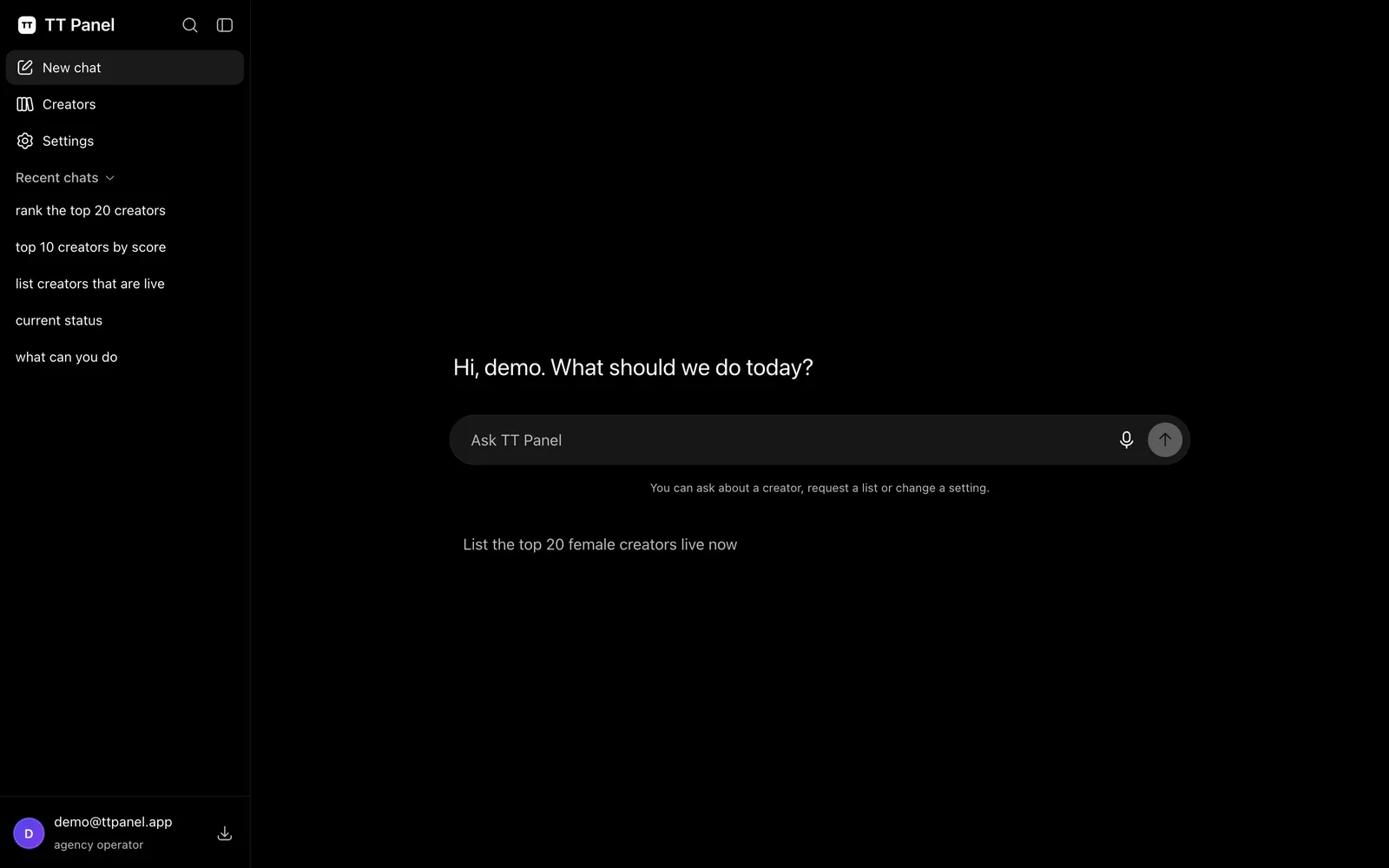
If you are going to use a tool, set the rule for it from the start. The problem is never doing a job with a tool, it is doing it without a rule: writing without checking eligibility, writing again and again to a creator who does not answer, not recording who wrote to whom and when, and ignoring the limits the platform sets. Whatever tool you use, the check before writing and the record of what was done should be part of the team's structure.
What records should you keep from day one?
A new agency's most expensive mistake is reaching a creator who is already tied to another agency. The policy lists building a management relationship with a creator who has already joined another agency's network, and poaching another agency's creators through improper means, both as prohibited behavior. The way to avoid this mistake is to check every creator's status before reaching out, and to record that check.
The record should show the date and time it was checked, and what the result was. A record that cannot be changed afterward carries more weight than anyone's word when there is a dispute. A screenshot or a hand kept spreadsheet will not do the job, because both are easy to edit.
The second important record is the list of creators who have told you they do not want to work with you. Everyone on the team should be able to see this list, and a name entered once should never fall back into the candidate list. A new hire disturbing an old name again does small but lasting damage to the agency's reputation.
What mistakes are common when setting up?
The most common mistake is dumping the candidate list into a shared spreadsheet in the first week and leaving it there. A spreadsheet works fine with a few names. As the number of names grows, the same creator gets entered twice, who looked at what gets lost, and old checks get mistaken for current ones.
The second mistake is putting speed ahead of structure. Reaching a large number of creators quickly can look like growth at first. A single agency bound creator reached without a check can put all of that growth at risk, and this risk is even bigger in the first months given the health score rule.
The third mistake is leaving the agency's knowledge in people's heads. If only one employee knows what was discussed with a creator, that knowledge leaves when the employee does. Notes and decisions should live somewhere that belongs to the agency, not to a person.
The fourth mistake is not writing down creators who said they do not want to work with you. In the first weeks this number is small and everyone remembers it. A few months later, when someone new joins the team, nobody remembers those names anymore and the same person gets contacted again. It is a mistake that looks small but wears down the agency's name fast.
Is there a short checklist before you start?
Yes. Have you decided which company the agency will be built on? Are your formation document, ownership information, executive information and identity document ready? Have you read the application requirements on the platform's current page? Can you describe your agency in two sentences? Do you have a consistent profile creators can find you on?
Does everyone on the team have their own login? Is it clear who finds candidates and who writes to them? Is a creator's status checked before you reach out, and is that check recorded? Is the list of creators who said no somewhere every team member can see? Does everyone on the team know the health score rule?
This guide is not legal or financial advice. Talk to an accountant, and a lawyer if needed, about company structure, tax and contract questions. TikTok's policy and application pages change over time; what we describe here reflects their state as of this guide's update date.
If you want to set your team up with structure from day one, request a walkthrough of the panel.
Request a walkthrough
Let us walk you through it in 30 minutes: the panel, the evidence record and how your team will work.