TikTok LIVE agency panel: why a spreadsheet stops being enough
Published:
Most agencies start out with a shared spreadsheet. This guide covers where a spreadsheet breaks down and what you should expect from a TikTok LIVE agency panel.
What is a TikTok LIVE agency panel, and why do you need one?
When we say TikTok LIVE agency panel, we mean the work screen where an agency brings its creator candidates, checks and team work together in one place. The platform also gives agencies its own management tools; this guide is not about replacing those, it is about the agency's own internal structure.
Most agencies use a shared spreadsheet before they notice this need. It is enough for the first weeks. The problem is that nothing tells you when the spreadsheet stops being enough. The candidate count grows, the team grows, and one day you find out that two people wrote to the same creator, or that someone reached a creator who was already tied to another agency.
In this guide we cover exactly where a spreadsheet breaks down, what to expect from an agency program or agency software, and what to ask when choosing one.
One note: the panel is not the thing that does the agency's job. Writing to a creator, talking and building the relationship is still the team's work. The panel's job is to put the right information in front of the people doing that work and to record what was done. Keep this difference in mind when comparing a vendor who promises this against one who claims to do everything.
Where does a shared spreadsheet break down?
The first break is duplicate rows. The same creator gets entered once by username, once by display name. The spreadsheet does not know they are the same person. Two different team members look at two rows, and both plan to write to the creator.
The second break is stale information. Is the note "independent", written last month, still true today? The spreadsheet cannot tell you. A cell's value stays the same until the person who wrote it changes it, while a creator's status can change every day.
The third break is losing history. Once a cell is changed, it is hard to see its old value, and harder still to see who changed it. When a dispute comes up, you have no reliable answer to what it said that day.
The fourth break is access. Once a spreadsheet link is shared, it becomes hard to track who holds it. That a former employee can still open the list is often only noticed months later.
What should you expect from an agency panel?
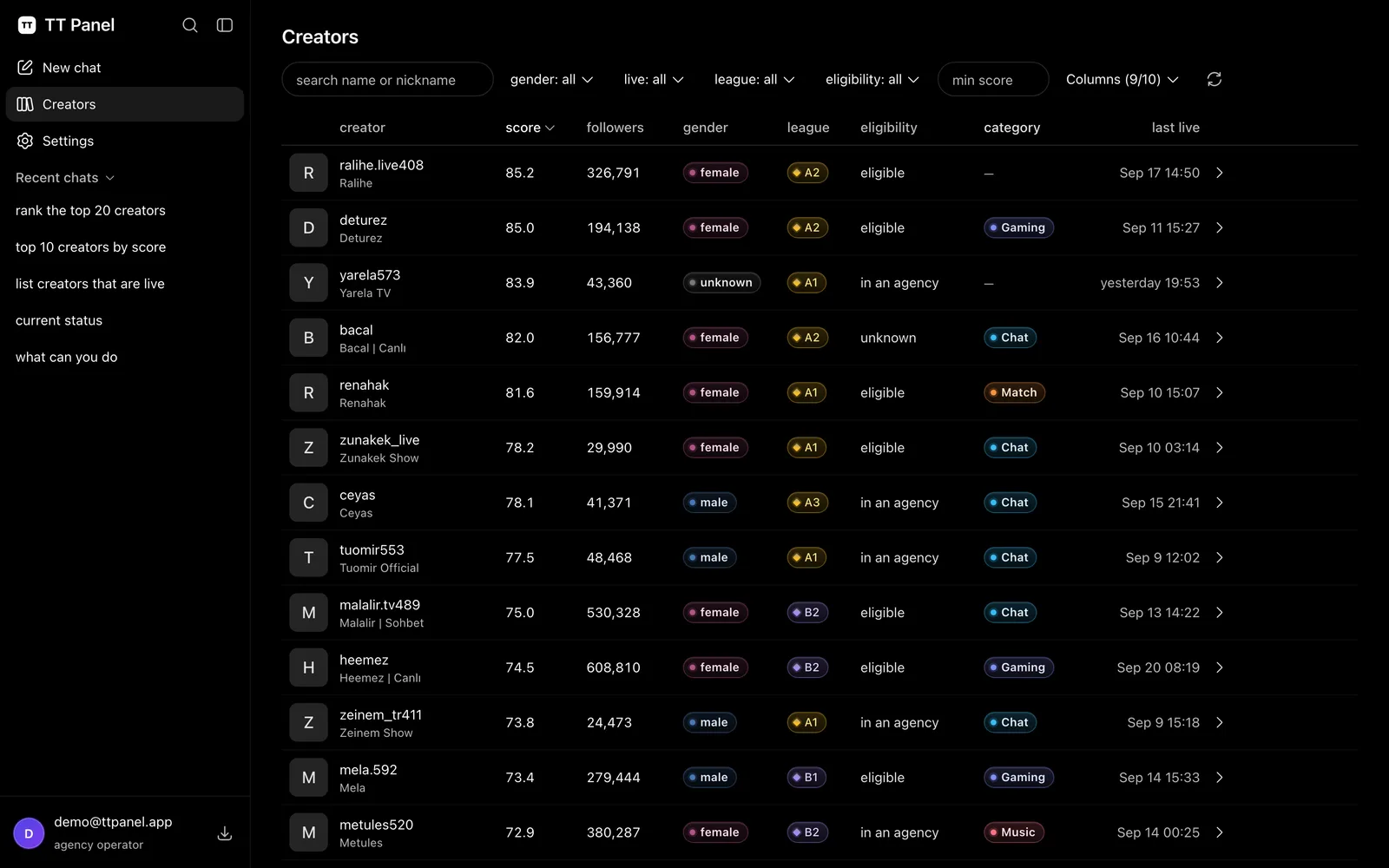
First, a single candidate list. Creators should sit in one pool, the same person should never appear twice, and adding a candidate by hand should also be possible. The list should show, in the same row, the information you look at when picking a candidate: followers, league, category and last live time.
Second, information that stays current. Whether candidates are still live should refresh regularly, and league history should be visible. Seeing who is trending by looking at history, rather than guessing, changes how you pick candidates.
Third, eligibility and record keeping. A structure where a creator's status is checked before you reach out, and that check is written to a record that is timestamped and cannot be changed afterward. A spreadsheet cannot do this, because every cell in it can be edited.
Fourth, team visibility. The agency owner should be able to see what the team did today on one screen, a team member should see only their own work and should not be able to touch settings, and every employee should log in with their own identity.
What changes once the candidate list grows?
With a small candidate list, you remember every name. With hundreds of candidates, remembering becomes impossible and ranking starts to matter. A structure that shows the team who to look at first, at the top of the list, directly affects how the team spends its day. Otherwise the team either moves at random or keeps going back to the same familiar names.
As the list grows, it also becomes critical that eliminated names do not come back. A creator who turned out to be tied to another agency, or who said they do not want to work with you, can get written to again by a new team member who does not know that history if the name falls back into the list. The panel should keep a name closed once it is eliminated, even as the team changes.
Where new names come from also changes. At first, the team searches for them. As the list grows, having new candidates land on the list without searching lets the team spend its time talking instead of searching.
A growing list also changes the agency owner's role. At first, the owner picks every name themselves. Past a certain point, the owner needs to look at the team's choices instead, to see where they are getting stuck. That depends on the list being the same for everyone, and on who looked at what being visible.
What questions should you ask when choosing a panel?
Where does your data sit? Are your agency's candidate list and records shared in a pool with other agencies, or kept in a space set aside for you? Is the list of creators who said they do not want to work with you yours alone?
Is the check recorded? Many tools can tell you whether a creator is eligible. The real question is whether the check leaves behind a record you can later prove was made. If the record can be edited, it is useless in a dispute.
Who runs it? Trusting your candidate list to an anonymous vendor you cannot reach tomorrow is a risk. Ask whether a real person answers when you write, what the support turnaround is, and where the data is kept.
Whose responsibility is compliance? No tool takes the responsibility of following platform rules off the agency's shoulders. A vendor who says this openly is more trustworthy than one who promises to do everything.
We put together a longer list of questions to keep in front of you when talking to a vendor in our guide on choosing agency software.
How does TT Panel answer these needs?
TT Panel is a work panel built for TikTok LIVE agencies. Your candidate list is collected in one place, and the same creator never appears twice. League history, category and last live time show up in the same row, and the list refreshes regularly. Clicking a row opens the creator's file: everything known about a creator on one page.
You keep an unchangeable, timestamped record that you checked a creator's status before writing to them. If a dispute comes up, you pull an evidence package for a single creator or a date range. A team member sees only their own work, every employee signs in with their own identity, and access for someone who leaves closes from one place.
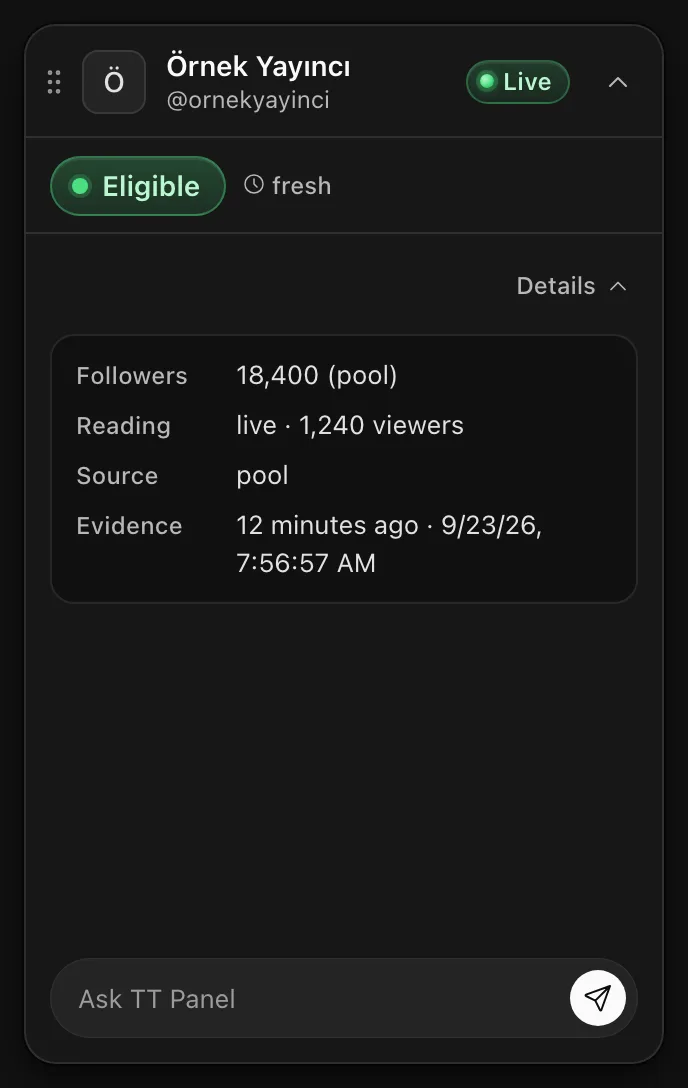
There is also a browser extension for the team to see the status of the creator they are looking at without leaving the page while browsing TikTok. Writing to and talking with a creator stays the team's job; the panel's job is to surface the right name and record what was done.
When should you move from a spreadsheet to a panel?
There is no exact threshold, but there are signs. If you have ever noticed two people writing to the same creator, that already shows the spreadsheet is not tracking who looked at what. If closing an employee's access was ever difficult, your access structure is already broken.
There is also the question, did we already look at that creator. If this comes up even once a week on your team, checks are not being recorded. Setting this record up before a dispute happens is far easier than trying to build it after one.
You do not have to drop the whole spreadsheet in a single day for the switch. Start by collecting new candidates in the panel and keep the old spreadsheet only for reading. Within a few weeks you will notice nobody looks at it anymore.
The part of the switch that takes the most time is figuring out how reliable the old spreadsheet's information is. Most of the "independent" notes in it may be outdated. Rather than carrying them into the panel as is, it is better to check again before reaching out to each creator. An old note is a hint, not a check.
Request a walkthrough to see how the panel works with your own candidate list.
Request a walkthrough
Let us walk you through it in 30 minutes: the panel, the evidence record and how your team will work.